

Exploring the Eternal Grandeur of the Mosque of Ibn Tulun in Cairo
The Mosque of Ibn Tulun stands as one of Cairo’s most extraordinary architectural masterpieces, an unyielding testament to the glory of early Islamic civilization in Egypt. Nestled in the heart of Islamic Cairo, this imposing structure radiates a sense of calm, mystery, and majesty that captivates every traveler who ventures into its ancient embrace. Built in the 9th century by Ahmad Ibn Tulun, the Turkish governor of Egypt, this mosque remains one of the city’s oldest and largest religious sanctuaries. Its dusty red-brick exterior and immense courtyard whisper stories from centuries gone by, while its famed spiral minaret towers majestically over Cairo’s skyline, echoing the grandeur of early Abbasid inspiration.
Tourists from every corner of the globe are frequently drawn to the Mosque of Ibn Tulun because of its distinctive design, timeless beauty, and cultural depth. It isn’t just a place of prayer — it’s a symbol of power, innovation, and architectural mastery. Unlike other religious monuments in Egypt, the mosque showcases an elegant austerity, perfectly balanced with detailed artistry. Its symmetrical layout, adorned with stucco decorations and Kufic calligraphy, creates a fascinating visual experience ideal for those interested in Egypt’s Islamic history. Visiting the Mosque of Ibn Tulun often feels like stepping into a time capsule that predates the bustling modern city of Cairo itself. It’s no surprise that it’s featured in many Egypt Day Tours and cultural itineraries offered by premier agencies such as Travme Tours.
Historical Significance and Origin of the Mosque of Ibn Tulun
The mosque’s story begins with Ahmad Ibn Tulun, who governed Egypt under the Abbasid Caliphate during the 9th century. Determined to establish Egypt as an autonomous province, Ibn Tulun envisioned a capital, Al-Qata’i, where his power and cultural vision could flourish unhindered. In 876 AD, he commissioned the construction of this immense mosque as the spiritual and political centerpiece of his new city. Inspired by the grand mosques of Samarra in Iraq, the Mosque of Ibn Tulun served as much more than a religious edifice — it symbolized Egypt’s ascent as a distinct Islamic hub.
The mosque’s construction took approximately three years, utilizing brick and plaster overlaid with intricate geometric motifs and carved stucco. Once completed in 879 AD, it became a spiritual refuge and a statement of independence. It’s said that the site itself was chosen due to a divine dream Ibn Tulun had, where he saw himself standing on a mountain of fire that didn’t harm him — a symbol interpreted as divine approval for his monumental project. Over the centuries, this sacred site remained unscathed by Cairo’s periodic upheavals, surviving both time and political shifts while preserving its original character. Many historians consider it one of the most authentic examples of early Islamic architecture not only in Egypt but across the entire Islamic world.
Architectural Brilliance and Layout
The Mosque of Ibn Tulun surprises visitors with its vast open courtyard surrounded by a covered arcade known as a riwaq. Its rectangular shape follows the traditional hypostyle pattern, yet what sets it apart is its sense of proportion and harmony. The mosque occupies over 26,000 square meters, allowing an awe-inspiring perception of space and light. The architectural plan remains remarkably well-preserved, largely due to the quality of craftsmanship and the use of fire-resistant materials.
The minaret, famously designed with an external spiral staircase similar to Iraq’s Great Mosque of Samarra, is perhaps the most recognized feature. Climbing to the top rewards visitors with panoramic views over ancient and modern Cairo — a breathtaking experience comparable to standing at the Cairo Tower. Each arch and pillar in the mosque displays subtle carvings that symbolize the Abbasid influence. Its prayer hall, directed toward the qibla, features a beautifully carved wooden minbar and ornate mihrab. The balance of light, shadow, and spartan beauty within this mosque is a hallmark of its enduring design.
The Courtyard and Its Serenity
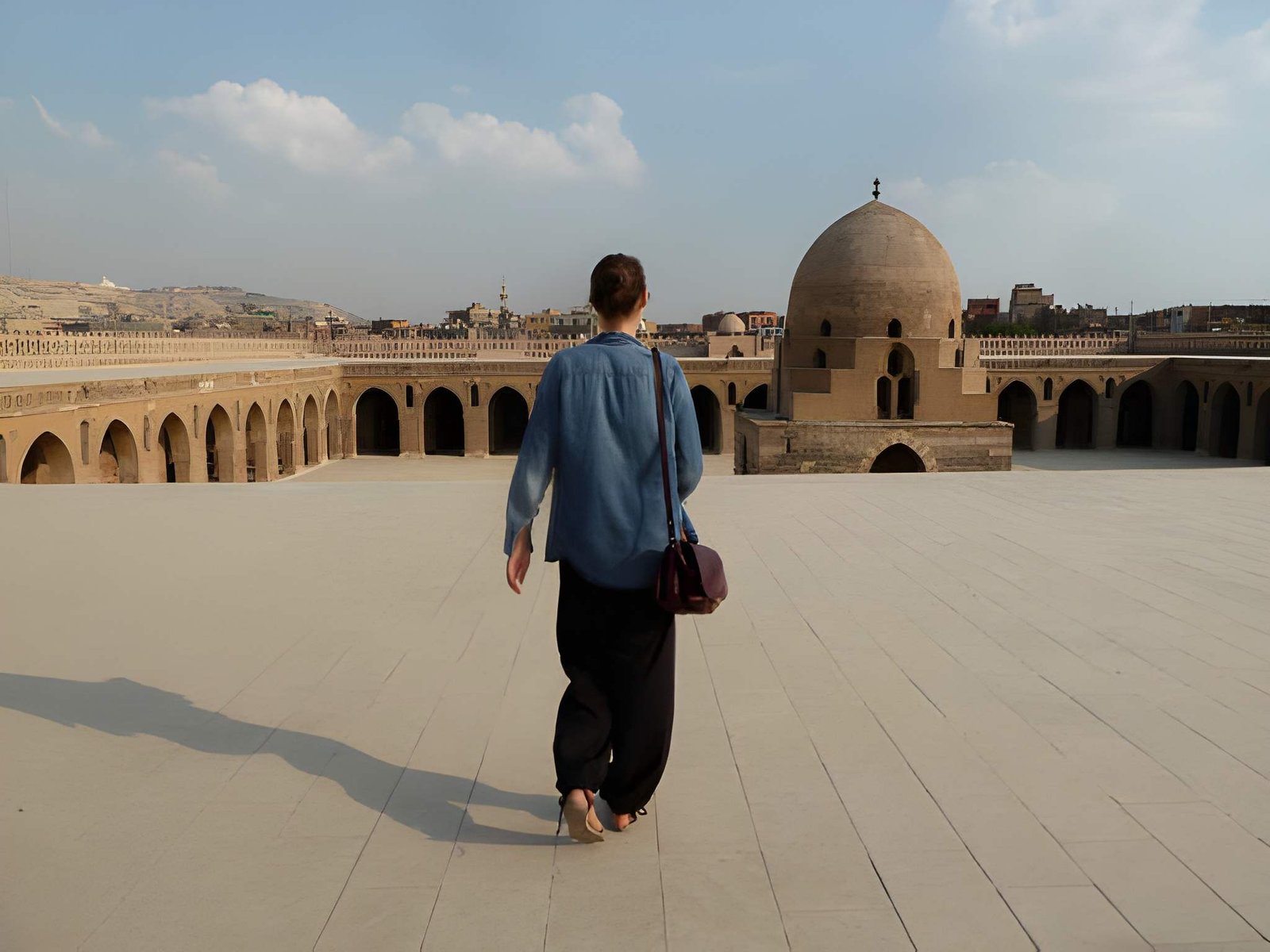
The marble-paved courtyard of the Mosque of Ibn Tulun unfolds as an oasis of tranquility amid Cairo’s bustling chaos. Its large ablution fountain, built in the 13th century by Sultan Lajin, stands gracefully at the center beneath a domed canopy. Though this addition came centuries later, it complements the mosque’s design seamlessly. The courtyard’s spaciousness and the rhythmic repetition of archways offer photographers endless opportunities to capture breathtaking symmetry and serene ambience. Those who’ve wandered through El Moez Street often find this mosque to be its calmer, more reflective counterpart — an oasis of peace in the heart of history.
Spiral Minaret: A Symbol of Power and Artistry
The mosque’s extraordinary spiral minaret remains one of Egypt’s most unique structures. Rising elegantly above the courtyard, it symbolizes both spiritual ascent and architectural mastery. Scholars debate whether its design was influenced directly by the minaret of Samarra or Ibn Tulun’s own creative innovations. What’s certain is its compelling presence — the winding staircase spiraling upward evokes a sense of dynamic motion, inviting visitors to explore the connection between heaven and earth. From the top, you can witness Cairo’s skyline blending ancient mosques, towering minarets, and modern buildings — a fitting metaphor for the city’s layered history.
Materials, Restoration, and Preservation
Constructed primarily from red brick covered in plaster, the mosque’s composition has withstood centuries of climate and conflict. The absence of elaborate marble or decorative tiles gives it a sense of purity unmatched by later Fatimid or Mamluk architecture. Thanks to meticulous restoration projects in the 20th century, the mosque continues to retain its structural integrity. Its simple materials carry more than aesthetic significance — they reflect Ibn Tulun’s vision for endurance and spiritual substance over ostentation. Today, conservationists maintain the mosque as a living heritage site, ensuring future generations can experience its timelessness firsthand.
Cultural Impact and Modern-Day Visits
In modern times, the Mosque of Ibn Tulun has transcended its role as a place of worship to become a hub for cultural and historical appreciation. It serves as a bridge linking the medieval Islamic world to contemporary Egypt. The mosque frequently appears in films, travel photography, and architectural studies, drawing thousands of enthusiasts and scholars annually. Its proximity to the Citadel of Salah El-Din and other Islamic landmarks such as the Al Azhar Mosque makes it a cornerstone of any comprehensive Cairo travel guide.
Tourists can explore the mosque freely, wandering its arcades and courtyards with little constraint. The calm atmosphere, combined with historical context and artistic charm, offers a deeply immersive experience. For travelers planning to see Cairo’s architectural grandeur, pairing a visit here with a stop at the Al Rifai Mosque or Sultan Hassan Mosque provides an extraordinary insight into Islamic architecture’s evolution across eras.
The Mosque of Ibn Tulun in Egyptian Heritage and Architecture
Architecturally, the mosque represents more than an early Islamic monument — it is a blueprint that influenced countless structures across North Africa. Its emphasis on spacious courtyards, rhythmic arcades, and minimal ornamentation established a distinct style that echoed through later Egyptian mosques. As one of the earliest surviving examples of an entirely preserved congregational mosque, it continues to serve as a reference point for architectural historians globally.
Moreover, its role within Cairo’s evolving landscape cements it as a cultural landmark. Situated between the bustling neighborhoods of Sayyida Zeinab and the ancient quarters of Fustat, the mosque anchors the city’s historical narrative. The view from its minaret on a clear day reaches across landmarks like the Egyptian Museum and beyond, linking the ancient and the modern in a single glance. For travelers passionate about exploring religious art and heritage, including this mosque within an Egypt Luxury Tour itinerary creates an unforgettable balance of spirituality and history.
Why Travelers Fall in Love with the Mosque of Ibn Tulun
What fascinates most visitors is the mosque’s atmosphere — open, peaceful, and full of light. Its geometric elegance and historical authenticity strike a chord with modern-day explorers eager to escape Cairo’s urban bustle and dive into its ancient soul. For cultural travelers, photographers, and architecture lovers alike, Ibn Tulun’s legacy provides a quiet invitation to reflect on the timelessness of human creativity and devotion.
No other mosque in Cairo quite captures that balance of scale, simplicity, and sanctity. Every arch whispers stories of scholars, rulers, and faithful worshippers who once congregated under its sprawling roof. Each sunrise paints golden tones across its redbrick walls, breathing new life into the centuries-old sanctuary. Whether you’re joining a day tour from Cairo or tracing Egypt’s Islamic heritage on foot, a visit here is nothing short of inspiring.
FAQs about the Mosque of Ibn Tulun
1. Who built the Mosque of Ibn Tulun and when?
The Mosque of Ibn Tulun was built by Ahmad Ibn Tulun, the Turkish governor of Egypt under the Abbasid Caliphate, between 876 and 879 AD. It served as the central mosque for his new capital, Al-Qata’i, symbolizing independence and political strength.
2. What is unique about the Mosque of Ibn Tulun’s architecture?
The mosque is famed for its vast open courtyard, redbrick structure, and striking spiral minaret — the only one of its kind in Egypt. Its geometric arches, symmetrical layout, and lack of excessive ornamentation highlight early Abbasid influences and minimalist elegance.
3. Can visitors climb the spiral minaret?
Yes, visitors can climb the spiral minaret, which provides spectacular panoramic views of Cairo. The climb offers a unique perspective over historical landmarks and showcases the mosque’s position as one of the city’s highest points of heritage architecture.
4. Where is the Mosque of Ibn Tulun located?
The mosque is located in the Sayyida Zeinab district of Cairo, within the historic core known as Islamic Cairo. It is close to major attractions like the Citadel of Salah El-Din and the Al Azhar Mosque, making it easily accessible during cultural tours.
5. What’s the best time to visit the Mosque of Ibn Tulun?
The best time to visit is early morning or late afternoon when sunlight casts mesmerizing shadows across the courtyard. Visitors planning an extended Cairo itinerary can combine this visit with nearby landmarks or include it in Best Egypt Travel Packages that highlight Egypt’s finest Islamic sites.

Comment (0)